Early Payoff Mortgage Calculator
By the YourHomeCosts editorial team. Updated .
Estimate
95 months shorter
Interest in this estimate is $97,618.44 lower than the scheduled remaining term.
- Scheduled principal and interest
- $1,580.17
- Months on the schedule
- 360
- Months with these extras
- 265
- Interest on the schedule
- $318,861.58
- Interest with these extras
- $221,243.14
Estimates only; your lender's numbers win.
Educational information only. This is not financial, tax, legal, lending, insurance, or appraisal advice. Loan documents, state law, and your servicer or assessor control. Confirm every figure before you act.
How to use this calculator
Type the principal balance, the interest rate, and the years still left on the note. Then type any extra principal you plan to add every month, and any lump sum you would apply now. Leave an extra at zero if you are not sending one. “Use the example” restores $250,000, 6.5 percent, 30 years, $200 a month, and no lump sum.
The scheduled payment is the fixed principal and interest that amortizes the balance you typed over the years you typed, at the rate you typed. The second column keeps that same required payment and adds the extra principal and the lump sum. The payment is not rebuilt. A recast, which does rebuild it, is a different form.
Nothing you type is stored. The rate is whatever you enter. It is not a quote and not a national average. If the payment would not cover the interest, the form says so instead of inventing a payoff date.
What affects the number
The months you save depend on the balance, the rate, the remaining term, the extra you add each month, and any lump sum applied at the start. A higher rate means more of each scheduled payment is interest, so the same extra dollar retires principal that would have generated more interest. A lower rate does the reverse. The term matters because a longer remaining schedule has more months of interest for the extra payment to skip.
In plain English, the schedule works like this. Divide the annual rate by 12. Interest for the month is the unpaid balance times that rate, rounded to the cent the way this estimate rounds. Principal is the scheduled payment minus that interest. Extra principal, and a lump sum at the beginning, reduce the balance before later interest is calculated. The last scheduled month absorbs a leftover of less than one full payment so a 30-year term stays 360 months when you add nothing.
The required payment stays on the old schedule. The CFPB says you may be allowed to pay extra principal, that you should read the note for a prepayment penalty, and that the extra should be applied to principal rather than interest. If the note has a penalty, this calculator does not know it and does not subtract it. Read the note before you send a large extra.
A yearly extra or a biweekly plan is a different pattern. The mortgage payoff page can add a once-a-year amount and can count 26 half-payments as one extra monthly payment a year. This page keeps the inputs to a monthly extra and a lump sum so the comparison stays one chart. Both pages use the same schedule. Neither one is a payoff quote.
Escrow for taxes and insurance is not in the payment this form amortizes. Sending extra to principal does not change the escrow deposit. How that deposit is rebuilt is on the escrow analysis page. Mortgage insurance is also separate. Crossing 80 percent of original value is the PMI removal calculator, using the Homeowners Protection Act, not a side effect this form can claim.
What your results mean
“Months on the schedule” is how long the required payment takes to finish the balance with no extra. “Months with these extras” is the same payment plus what you typed. “Months shorter” is the difference. Interest saved is the interest on the plain schedule minus the interest on the shorter one. Both interest figures are sums of the monthly interest in the estimate, not a lender’s payoff worksheet.
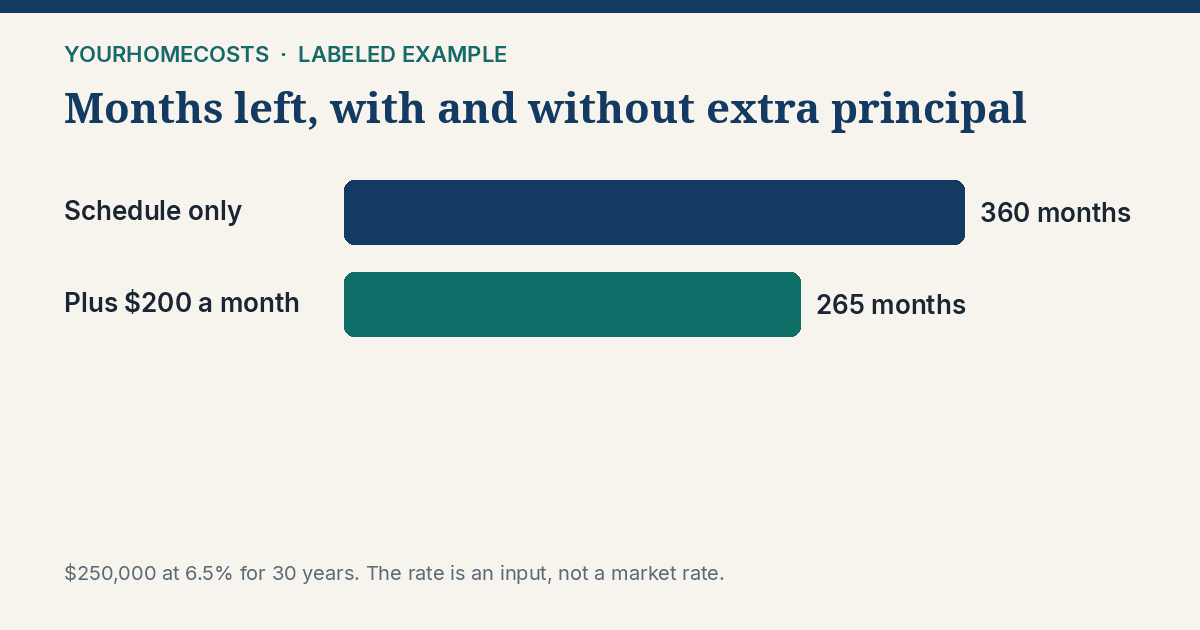
The labeled example is $250,000 at 6.5 percent with 30 years left and $200 extra every month, and no lump sum. The chart compares the months. The table lists the scheduled principal and interest, the months, and the interest on each path. Those cents come from the formula above. They are not a bill. Change any input and the card above replaces the table for your own numbers. The table stays on the labeled example so the article and the chart describe the same case.
A lump sum at the start drops the balance before the first month of this estimate. It does not lower the required payment. If you want the required payment to fall and the term to stay, that is a recast, estimated on the mortgage recast calculator. On a recast, keeping the old payment after the lump sum is usually the path that saves more interest. This page is that keep-paying path, including a monthly extra that is not a one-time lump sum.
The payoff date is not shown here because this form does not ask for a start date. The mortgage payoff explainer can place the estimate on a calendar date. Either way, the servicer’s payoff statement is the amount that actually closes the loan, including interest through the payoff date and any fees the statement lists.
| Schedule only | Plus $200 a month | |
|---|---|---|
| Scheduled principal and interest | $1,580.17 | $1,580.17 |
| Months left | 360 | 265 |
| Interest left | $318,861.58 | $221,243.14 |
| Months shorter | 0 | 95 |
| Interest saved | $0.00 | $97,618.44 |
What to do next
Decide which result you want. A shorter loan with the same required payment is this calculator. A lower required payment, same rate and same payoff month, is the mortgage recast calculator. A new rate or a new term is a refinance, with closing costs on a Loan Estimate, not a field on this page. The 50-year mortgage page compares a longer term, which raises total interest, with a 30-year term. A longer term is the opposite of paying off early.
If you are close to 80 percent of the home’s original value, extra principal can support a written PMI cancellation request. It does not move the automatic 78 percent date by itself. Run the balance against original value on the PMI removal calculator, then read how to remove PMI before you write the servicer. What is PMI explains who the premium protects.
Tell the servicer the extra is for principal, and check the next statement to see that it posted that way. If you need the exact amount to pay the loan off on a chosen day, ask for a payoff statement. The mortgage payoff page describes that statement, including the seven-business-day timing rule in Regulation Z. This estimate is the planning figure you compare with that statement. It is not a substitute for it.
Is paying extra principal worth it?
It is worth pricing when the note allows extra principal without a penalty you are unwilling to pay, and when you can spare the cash. The interest you skip is the gain this calculator can show. It does not know what that cash would earn somewhere else, and it does not tell you to send it.
It is a weaker fit when the payment is already tight. Adding principal and then missing the required payment is not a savings plan. A recast spends a lump sum to lower the required amount and gives up some of the interest savings. Compare the two results before you pick. This site does not rank them.
If you are comparing an early mortgage payoff with other uses of the cash, run two or three amounts here, such as $100, $200 and $500 a month, and note how the months and the interest change. The gain per extra dollar is largest early in the loan, when most of each scheduled payment is interest. Later in the schedule, the same extra dollar skips fewer months of interest. The calculator shows that pattern for your inputs. It does not know your other debts, your emergency fund, or the note's prepayment terms.
Bottom line
Bottom line: if you can keep paying the scheduled amount and add principal, this early payoff mortgage calculator shows the shorter path. If you need the required payment to fall, use the mortgage recast calculator instead. If the balance is nearing 80 percent of original value, the PMI removal calculator is the percentage test, not this one.
How we checked this: the labeled example was recomputed with the same month-by-month schedule the mortgage payoff page uses, from the inputs shown, on October 20, 2026. By the YourHomeCosts editorial team. General information, not legal, tax, or financial advice.
FAQ
Does extra principal lower my required mortgage payment?
Not by itself. The required principal and interest stays on the old schedule unless the servicer re-amortizes the loan. That re-amortization is a recast. This calculator keeps the old payment and shows a shorter term.
How does the early payoff mortgage calculator count interest?
Month by month. Interest is the unpaid balance times the monthly rate, rounded to the cent. Principal is the scheduled payment minus that interest, plus any extra you typed. The next month’s interest uses the new balance.
What is the labeled example?
A $250,000 balance, 6.5 percent, 30 years remaining, and $200 extra each month, with no lump sum. The 6.5 percent is an input chosen for the example. It is not a market rate. The table uses those inputs and no others.
Is a lump sum the same as a recast?
No. A lump sum here reduces the balance and the term if you keep paying the old amount. A recast uses a lump sum to lower the required payment and leave the payoff month where it is. Price that on the mortgage recast calculator.
Will extra payments remove PMI?
They can bring the balance to 80 percent of original value, which is when you may ask in writing. They do not, by themselves, move the automatic termination date at 78 percent of original value on the initial schedule. The PMI removal calculator does that percentage math. The servicer decides.
Is this a payoff quote?
No. A payoff quote is the servicer’s statement of the amount due through a stated date. This page estimates months and interest from the numbers you type. Estimates only. Your lender’s numbers win.
Sources
Educational information only. This is not financial, tax, legal, lending, insurance, or appraisal advice. Loan documents, state law, and your servicer or assessor control. Confirm every figure before you act.