PMI Removal Calculator
By the YourHomeCosts editorial team. Updated .
Estimate
$15,000.00 above 80%
A written request uses 80 percent. Automatic termination uses 78 percent of original value on the initial schedule, if you are current. Extra payments do not, by themselves, move that automatic date.
- 80% of original value
- $240,000.00
- 78% of original value
- $234,000.00
- Still above 80%
- $15,000.00
- Still above 78%
- $21,000.00
- Midpoint of the term you entered
- 15 years
Estimates only; your lender's numbers win.
Educational information only. This is not financial, tax, legal, lending, insurance, or appraisal advice. Loan documents, state law, and your servicer or assessor control. Confirm every figure before you act.
How to use this calculator
Enter the original value and the current principal balance. Original value has a statutory meaning. On a purchase it is the lesser of the sales price in the contract and the appraised value at the time of loan consummation. On a refinance of a principal residence it is the appraised value the lender used to approve that refinance. Those definitions are in 12 U.S.C. § 4901. A listing price, a refinance appraisal from a later loan, or a number you hope the house is worth is not that figure.
The optional term is only for the midpoint note. Leave it blank if you do not want that line. A 30-year term shows 15 years, which is how the CFPB describes the midpoint of a 30-year loan. The calculator does not know your closing date, so it cannot name the calendar month on your disclosure.
Press nothing. The result updates as you type and stays in the browser. “Use the example” restores a hypothetical $300,000 original value, a $255,000 balance, and a 30-year term. Those inputs are an illustration. They are not a sample loan from the CFPB and not a premium.
What affects the number
In plain English, the request line is 80 percent of original value and the automatic line is 78 percent of that same original value. Multiply, then compare the product with the principal balance. The dollars still above each line are the balance minus that product, and never less than zero. Nothing else in the formula uses a rate, a PMI premium, or a guessed home price.
Whether you may actually stop paying depends on facts this arithmetic does not know. 12 U.S.C. § 4902 lets you ask, in writing, on the cancellation date, which for a fixed-rate loan is when the balance is first scheduled to reach 80 percent of original value. You can ask sooner when extra payments bring the balance there. You also have to be current, have a good payment history, have no junior lien, and give evidence, if the servicer asks, that the value has not fallen below the original value. The CFPB’s cancellation page, last reviewed August 28, 2026, restates those conditions for single-family principal residences closed on or after July 29, 1999.
Good payment history, in § 4901, is no 60-day late in the year that starts 24 months before the later of the cancellation date or the request, and no 30-day late in the 12 months before that later date. A junior lien has to be gone, or the servicer can wait. Evidence of value, if requested, has to be a type the servicer set out in advance.
Automatic termination is a different date. For a fixed-rate loan, § 4901 sets it when the balance is first scheduled, on the initial amortization schedule, to reach 78 percent of original value. The balance that day does not change the date. If you are not current, § 4902(b) waits until the first day of the first month after you are. Extra payments can support the written request. They do not, by themselves, move this automatic date. Section 4902(c) is the final stop: PMI may not be required after the first day of the month following the midpoint of the amortization period, if you are current. The CFPB says that midpoint on a 30-year loan is after 15 years. A modification recalculates the dates under § 4902(d). A recast is not automatically that kind of modification.
Section 4902(g) says the request rule and the automatic 78 percent rule do not apply to certain high-risk loans. In the mortgagee’s category under that subsection, termination is scheduled at 77 percent of original value, and the midpoint rule still applies. The result card leads with 80 and 78. The worked example also shows 77 percent so that category is visible. This page cannot tell you that your loan is in it.
Lender-paid mortgage insurance is outside this calculator. The CFPB says it follows different rules. Do not read § 4901 as if it defined lender-paid coverage the same way. FHA mortgage insurance and the VA funding fee are different products on the CFPB’s page. USDA loans are outside the § 4901 definition of private mortgage insurance, which points to title V of the Housing Act of 1949. Investor guidelines, including any current-value appraisal a servicer offers, cannot be less favorable than the statute. This page does not restate an investor’s current-value policy.
What your results mean
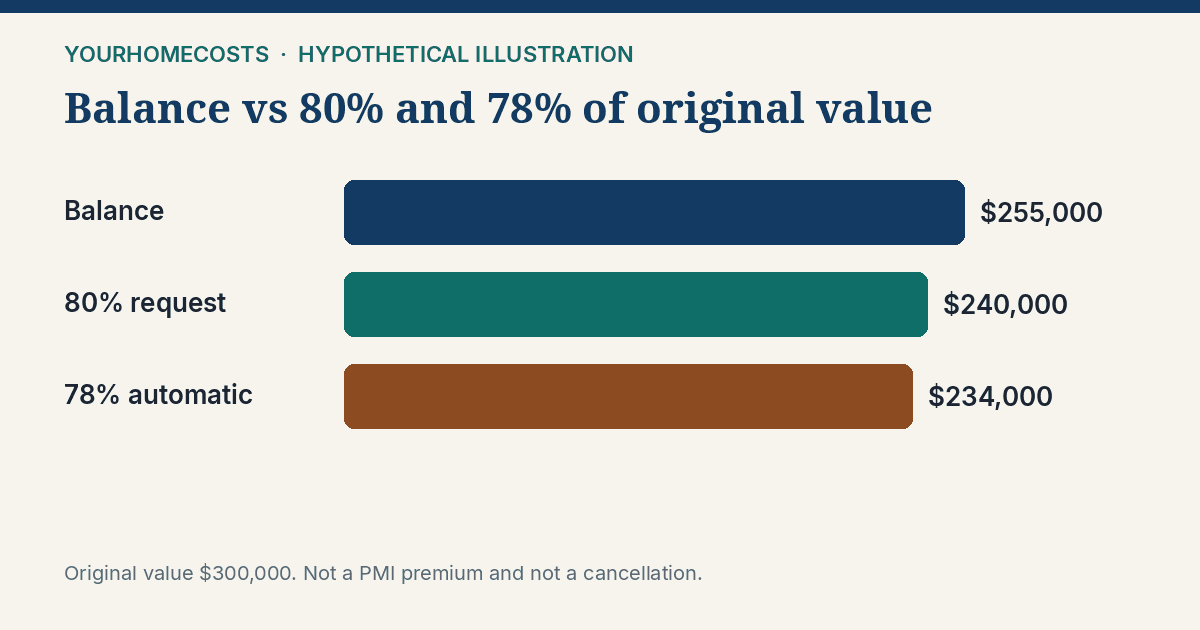
The hypothetical illustration uses a $300,000 original value and a $255,000 principal balance. Eighty percent of $300,000 is $240,000. Seventy-eight percent is $234,000. The balance is $15,000 above the request line and $21,000 above the automatic line. Seventy-seven percent, the high-risk mortgagee category, is $231,000. A 30-year term has its midpoint at 15 years. None of those figures is a premium, a bill, or a date the servicer has agreed to.
If you change the balance to $240,000, the request line is met on these inputs and the automatic line is not. Meeting the percentage is the start of a request, not the end of the premium. You still have to write, be current, meet the payment-history test, have no junior lien, and show value if asked. If the balance is $234,000, both percentages are met on the arithmetic. Automatic termination still depends on the initial schedule and on being current. The chart draws the balance you would need, not a promise that PMI has ended.
“Still above 80%” is the principal that would have to be gone, by scheduled payments or by extra principal, before the balance equals 80 percent of the original value you typed. It is not a payoff quote. The mortgage payoff page and the early payoff calculator estimate how extra principal changes a balance over time. They do not send the cancellation letter. A recast lowers the required payment after a lump sum. It does not, by itself, remove PMI.
Read the result as a comparison of three numbers: your balance, 80 percent, and 78 percent. The servicer’s figure for original value controls.
| Line | Amount |
|---|---|
| Original value | $300,000 |
| Principal balance | $255,000 |
| 80% of original value | $240,000 |
| 78% of original value | $234,000 |
| Still above 80% | $15,000 |
| Still above 78% | $21,000 |
| 77% high-risk category | $231,000 |
| Midpoint of a 30-year term | 15 years |
What to do next
Find original value in the closing file: the contract price and the appraisal at purchase, or the appraisal used on a refinance of your principal residence. Then compare the principal balance on the statement with 80 percent of that value. If you are at or under it, the next step is a written request to the servicer, not another pass through this form.
Ask what evidence of value the servicer will accept, and send that only if they ask. Keep the request and the answer. Section 4902(e) says the servicer may not keep collecting PMI premiums more than 30 days after the relevant date. Section 4902(f) says unearned premiums come back within 45 days after termination or cancellation. Premiums already earned can still be collected under § 4902(h). Those clocks are the statute’s. They are not a refund this site can start.
If the balance is still above 80 percent and the goal is to get there sooner, extra principal is the lever. Price that on the early payoff calculator. If you would rather cut the required payment than shorten the loan, price a lump sum on the mortgage recast calculator and then ask the servicer whether the PMI dates change. The longer explanation of the request, the automatic date, and the final midpoint is on how to remove PMI. What is PMI covers who the premium protects and how it shows up on a Loan Estimate.
When does PMI have to end?
On a covered fixed-rate loan, you can ask at 80 percent of original value, and the servicer generally must end borrower-paid PMI at 78 percent of original value on the initial schedule if you are current. If you are not current that day, it waits until you are. The midpoint of the amortization period is the final stop if the schedule has not already ended the premium. Loans treated as high-risk under § 4902(g) are outside the ordinary request and automatic rules; for the mortgagee-determined category, termination is scheduled at 77 percent of original value, and the midpoint rule still applies.
That is the federal floor for the loans the statute covers. It is not FHA, VA, USDA, or lender-paid mortgage insurance. If the disclosure and this page disagree about the date, the disclosure controls the premium.
Bottom line
Bottom line: type the original value from the loan, not a guess of today’s price. If the balance is still above 80 percent, the dollars shown are principal still to go before a written request even starts. The servicer applies the statute. The how to get rid of PMI page walks through the request, and what is PMI says who the premium protects.
How we checked this: the 80 percent and 78 percent rules are taken from 12 U.S.C. §§ 4901 and 4902 and from the CFPB cancellation page, last reviewed August 28, 2026. The hypothetical arithmetic was recomputed from the inputs shown. By the YourHomeCosts editorial team. General information, not legal, tax, or financial advice.
FAQ
What is the PMI removal calculator actually doing?
It multiplies the original value you enter by 0.80 and by 0.78, then subtracts each product from the balance when the balance is higher. The 77 percent line is included because § 4902(g) uses it for a defined high-risk category. No premium is estimated.
Does hitting 80 percent cancel PMI by itself?
No. The CFPB says the request has to be in writing, and you have to be current, have a good payment history, have no junior lien, and show that the value has not fallen if the servicer asks. The calculator only shows whether the balance you typed is at that percentage of the value you typed.
Why didn’t my extra payments move the 78 percent date?
For a fixed-rate loan, the termination date is when the balance is first scheduled to reach 78 percent on the initial amortization schedule. The actual balance does not reset that date. Extra payments can support an earlier written request at 80 percent. See 12 U.S.C. §§ 4901 and 4902.
Whose value do I type?
Original value from § 4901. On a purchase, the lesser of the contract price and the appraisal at the loan. On a refinance of a principal residence, the appraisal the lender relied on to approve that refinance. Not today’s list price.
Does this apply to an FHA or VA loan?
No. The CFPB says FHA mortgage insurance and VA loans follow different rules. USDA loans are outside the private-mortgage-insurance definition in § 4901. Use this page for borrower-paid PMI on a covered conventional loan, and ask that servicer before you treat the result as your date.
Where are the 80 percent and 78 percent rules written?
The Homeowners Protection Act states them in 12 U.S.C. §§ 4901 and 4902. The CFPB restates them at consumerfinance.gov/ask-cfpb/when-can-i-remove-private-mortgage-insurance-pmi-from-my-loan-en-202/. That page was last reviewed August 28, 2026.
Sources
Educational information only. This is not financial, tax, legal, lending, insurance, or appraisal advice. Loan documents, state law, and your servicer or assessor control. Confirm every figure before you act.