Property tax
States With No Property Tax (2026 List) | YourHomeCosts
By the YourHomeCosts editorial team. Last updated . General information, not tax, financial, or legal advice.
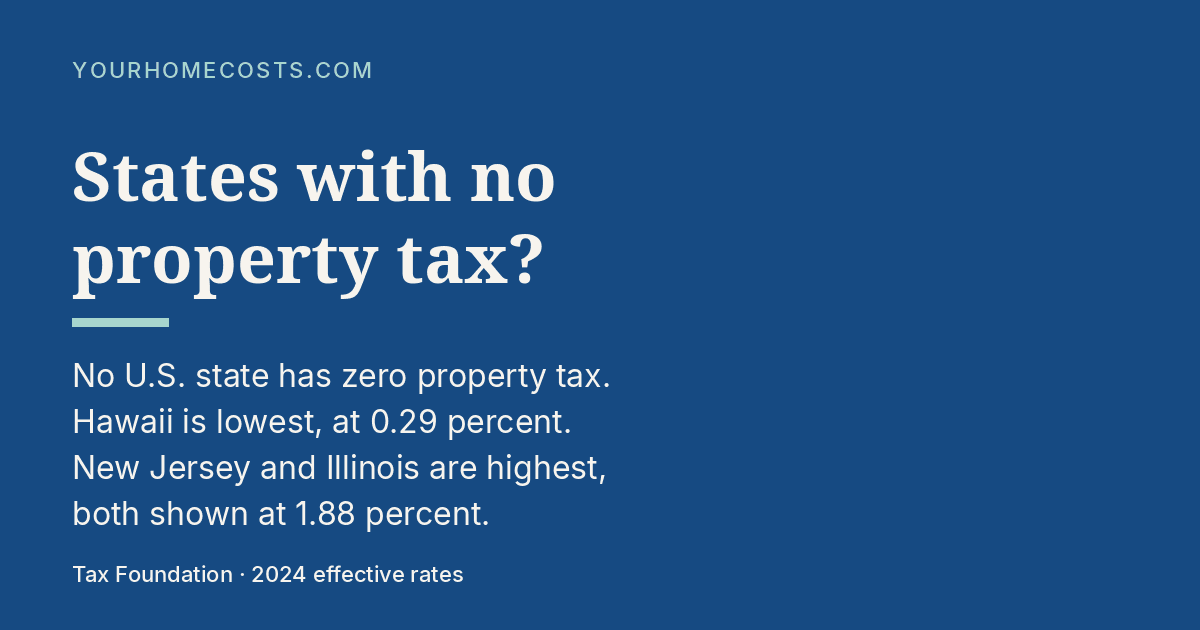
Are there any states with no property tax? No. No U.S. state has zero property tax. In the Tax Foundation’s 2024 table of effective rates on owner-occupied housing, all 50 states are above zero. Hawaii is lowest, at 0.29 percent. New Jersey and Illinois are highest, both shown at 1.88 percent, with New Jersey ranked first. This page is a 2026 list of those states. The percentages are 2024 figures, not 2026 bills.
An effective rate on this page is total real estate taxes paid divided by total home value, for owner-occupied housing. The Tax Foundation calculates it from U.S. Census Bureau American Community Survey datasets B25082 and B25090. Taxes on business property, renters, and other owners are left out. A state percentage is not the millage on one house, and it is not a quote for an address.
How we checked this: the Tax Foundation’s March 16, 2026 property-tax tables and the Census Bureau American Community Survey page, the Florida Division of Elections election-dates page and Amendment 3 record, sections 196.031, 196.075, and 197.122 of the Florida Statutes, and the Ohio Attorney General’s May 9, 2025 petition release and petition list were read on October 22, 2026.
Educational information only. This is not financial, tax, legal, lending, insurance, or appraisal advice. Loan documents, state law, and your servicer or assessor control. Confirm every figure before you act.
Estimates only; your lender's numbers win.
Does any state have no property tax?
No. Property tax in the United States is levied under state law, almost always by cities, counties, school districts, and other local governments. The Tax Foundation’s comparison for 2024 still finds an effective rate above zero in every state. The lowest printed rate is Hawaii at 0.29 percent. Alabama is next at 0.37 percent. Alaska, which is sometimes described as a low-tax state, is 0.94 percent in the same table, rank 20.
A low state rate is not a zero bill, and a high state rate is not the bill on every street. Counties inside one state can sit far apart, because each local government sets its own levy and because home values differ. The state figure answers a different question: of the owner-occupied housing value in that state, what share was paid in real estate tax. Use it to compare states. Use the tax bill to see one parcel.
Two proposals in the news do not change that list. Florida Amendment 3, on the November 3, 2026 ballot, would change exemptions and a cap. It would not set the tax to zero. Ohio has a certified petition title for an amendment that would abolish taxes on real property. That petition is not a repeal. Both are described below, from the official records, and neither is a recommendation on how to vote.
Which states have the lowest and highest effective rates?
The table lists all 50 states from the Tax Foundation’s 2024 column, in that source’s rank order. Rank 1 is the highest effective rate. Rank 50 is the lowest. Where the printed rate is the same, the table keeps the Tax Foundation’s order, which can reflect digits that the published percentage does not show. New Jersey and Illinois are the example: both print as 1.88 percent, and New Jersey is rank 1.
After those two, the highest rates in the table are Connecticut at 1.54 percent, Vermont at 1.51 percent, and New Hampshire at 1.50 percent. After Hawaii and Alabama, the lowest are Utah and Arizona, both shown at 0.48 percent, and South Carolina at 0.49 percent. Florida is 0.78 percent, rank 27. Ohio is 1.36 percent, rank 8.
The Census survey behind the table is not a 2026 assessment roll. The Tax Foundation article that prints these rates is dated March 16, 2026, and the column it labels is 2024. A renewal, a reassessment, or a new exemption can move one house without moving last year’s statewide ratio. The Florida property tax page shows the other kind of figure: taxable value times a local millage, with and without the homestead exemption.
| Rank | State | Effective rate |
|---|---|---|
| 1 | New Jersey | 1.88% |
| 2 | Illinois | 1.88% |
| 3 | Connecticut | 1.54% |
| 4 | Vermont | 1.51% |
| 5 | New Hampshire | 1.50% |
| 6 | Nebraska | 1.44% |
| 7 | Texas | 1.40% |
| 8 | Ohio | 1.36% |
| 9 | Iowa | 1.33% |
| 10 | Wisconsin | 1.32% |
| 11 | New York | 1.30% |
| 12 | Pennsylvania | 1.26% |
| 13 | Kansas | 1.21% |
| 14 | Michigan | 1.19% |
| 15 | Rhode Island | 1.12% |
| 16 | Massachusetts | 1.00% |
| 17 | Minnesota | 1.00% |
| 18 | South Dakota | 1.00% |
| 19 | Maine | 0.98% |
| 20 | Alaska | 0.94% |
| 21 | Maryland | 0.92% |
| 22 | North Dakota | 0.92% |
| 23 | Missouri | 0.89% |
| 24 | Oregon | 0.81% |
| 25 | Georgia | 0.79% |
| 26 | Oklahoma | 0.79% |
| 27 | Florida | 0.78% |
| 28 | Virginia | 0.78% |
| 29 | Indiana | 0.76% |
| 30 | Washington | 0.75% |
| 31 | Kentucky | 0.74% |
| 32 | California | 0.70% |
| 33 | North Carolina | 0.66% |
| 34 | New Mexico | 0.63% |
| 35 | Montana | 0.61% |
| 36 | Mississippi | 0.58% |
| 37 | Arkansas | 0.56% |
| 38 | Louisiana | 0.55% |
| 39 | Delaware | 0.54% |
| 40 | Wyoming | 0.53% |
| 41 | Tennessee | 0.52% |
| 42 | West Virginia | 0.51% |
| 43 | Nevada | 0.50% |
| 44 | Colorado | 0.50% |
| 45 | Idaho | 0.50% |
| 46 | South Carolina | 0.49% |
| 47 | Arizona | 0.48% |
| 48 | Utah | 0.48% |
| 49 | Alabama | 0.37% |
| 50 | Hawaii | 0.29% |
What would those rates be on a $300,000 home?
The worked example applies the printed 2024 effective rate to a round home value of $300,000. Tax is value times the rate. Hawaii at 0.29 percent is $870. Alabama at 0.37 percent is $1,110. Florida at 0.78 percent is $2,340. Ohio at 1.36 percent is $4,080. Illinois and New Jersey, each at the printed 1.88 percent, are $5,640. The gap from Hawaii’s illustration to New Jersey’s is $4,770.
That gap is arithmetic on a made-up value. It is not Hawaii’s tax on a $300,000 house, and it is not New Jersey’s. The effective rate is a statewide ratio of taxes paid to home value. A $300,000 market value can be assessed at a different number. Exemptions, caps, and local millages then apply to the assessed figure. Two houses at the same price in the same state can owe different amounts. The Florida illustration on the Florida property tax page uses one city’s millage and a homestead exemption. It will not match $2,340, and it should not. One number is a statewide ratio. The other is a labeled local bill.
Read the monthly column as the annual illustration divided by 12. A mortgage escrow deposit can be near that twelfth while a servicer is paying the tax. It can also include insurance, a shortage, or a cushion. What PITI is separates principal, interest, taxes, and insurance. The escrow analysis page is the yearly statement that collects the tax portion, not the tax itself. The payment explainer lines a tax figure from a statement you already have up against the monthly payment.
| State | Printed rate | Illustrated annual tax | Divided by 12 |
|---|---|---|---|
| Hawaii | 0.29% | $870 | $72.50 |
| Alabama | 0.37% | $1,110 | $92.50 |
| Florida | 0.78% | $2,340 | $195.00 |
| Ohio | 1.36% | $4,080 | $340.00 |
| Illinois | 1.88% | $5,640 | $470.00 |
| New Jersey | 1.88% | $5,640 | $470.00 |
How do homestead exemptions change the bill?
A homestead exemption reduces the value that is taxed, for an owner who lives in the home and meets that state’s tests. It does not erase the tax. The statewide effective rate already reflects the exemptions people actually used, because it is built from taxes paid, not from the posted millage. A buyer who newly qualifies can owe less than a neighbor who does not, even when the state ratio stays the same.
Florida is the concrete case on this site. Section 196.031, Florida Statutes, is the homestead exemption: an amount that applies to levies generally, and an additional amount that applies to levies other than school-district levies. The additional amount is adjusted when the price index changes, so a tax roll can use a dollar figure other than the statutory base. Save Our Homes limits how fast the assessed value of a homestead can rise. The Florida homestead exemption page covers who qualifies, the base amounts, portability, and the March 1 filing date. The Florida property tax page shows one worked bill with the exemption and one without it.
Other states use their own homestead exemptions, assessment caps, and income tests. This page does not restate those statutes. An exemption in the statute still has to be claimed where the state requires an application, and a local option applies only after the city or county adopts it.
If you think your assessed value is wrong, how to appeal a property tax assessment covers the steps.
What relief is available for seniors?
Senior relief is usually an extra exemption, a freeze, or an income test on top of the homestead rules. It is local as often as it is statewide. States write their own versions. Whether one applies at a given address comes from that state’s statute and, often, a local ordinance.
Florida’s senior homestead exemption is section 196.075. A county or a municipality may adopt an ordinance for a permanent resident who is 65 or older. One option is an additional exemption of up to $50,000 when household income does not exceed the income limitation. The statute states that limitation as $20,000 and adjusts it every January 1 by the change in the average cost-of-living index, so the dollar test on an application can differ from $20,000. A second option can exempt the assessed value for an owner who has lived in the homestead at least 25 years, is 65 or older, meets the same income limitation, and whose just value was less than $250,000 in the first year of eligibility. The long-tenure option needs a supermajority vote of the governing body.
Neither Florida option exists unless that county or city has adopted it. The exemption applies only to the taxes of the government that granted it. A city exemption does not, by itself, reduce the school or county bill. The Florida homestead exemption page is where the filing rules for that statute sit. This page does not list senior programs in the other 49 states, and it does not estimate the dollar savings of an ordinance that may not apply.
What is on the ballot in Florida?
Florida Amendment 3 is on the November 3, 2026 general election ballot. The Florida Division of Elections lists that Tuesday as Election Day for the 2026 general election. The Division’s initiative record gives the proposal ballot number 3. The official summary does not abolish property tax. It increases the homestead exemption for non-school taxes, to $150,000 in 2027 and $250,000 in 2028, with an inflation adjustment after that. It lowers the annual cap on assessment increases for non-homestead property from 10 percent to 5 percent. It also limits the purposes for which counties and municipalities may use property-tax revenue, with a path for other spending. The summary says the amendment takes effect January 1, 2027.
The Florida Amendment 3 page quotes the ballot title and summary from the Division of Elections booklet and keeps the arguments attributed to the people who made them. This page does not repeat that title in full and does not say how to vote. Current homestead law stays in place unless voters approve the amendment. A vote in November 2026 would not change a 2024 effective rate, which describes taxes that were already paid.
What is Ohio’s petition to eliminate property tax?
On May 9, 2025, the Ohio Attorney General accepted the petition title and summary of a proposed constitutional amendment, “Abolishment of Taxes on Real Property.” The proposal would add a Section 14 to Article XII of the Ohio Constitution. The Attorney General’s release says that office’s role, under Ohio Revised Code 3519.01, is to decide whether the title and summary fairly and truthfully describe the amendment. The certification letter quoted in the release says they do.
Acceptance of the summary is not a repeal, and it is not placement on a ballot. The same release describes the later steps: the Ohio Ballot Board decides whether the proposal is a single amendment, and if it certifies the proposal, the petitioners must then collect signatures from registered voters equal to at least 10 percent of the vote in the most recent gubernatorial election. Those signatures must include at least 5 percent of that vote in at least 44 of Ohio’s 88 counties. The Attorney General’s petition list records this initiative as certified on May 9, 2025. This page does not report a signature count, and it does not treat the proposal as current law.
Ohio still has a property tax in the 2024 table: 1.36 percent, rank 8. On the $300,000 illustration that printed rate is $4,080. A constitutional change, if it ever reached the ballot and passed, would be a later event. It is not in the Census figures this list uses.
Why do you still pay property tax after paying off the house?
The tax is on the property, not on the loan. Principal and interest stop when the note is paid. Property tax is set by state and local law for the year, whether or not a lender is involved. An owner with no mortgage can still receive a tax bill from the collector.
While the loan is open, a servicer may collect the tax inside the monthly payment and pay the collector from escrow. That arrangement ends when the loan ends. The obligation to the taxing government does not. What PITI is names taxes as one of the four letters, separate from principal and interest. The escrow analysis page explains the account, the shortage, and the cushion only for the years a servicer is holding the money.
Florida states the lien directly. Section 197.122 says taxes imposed under the state constitution and laws are a first lien, superior to other liens, on the property against which they were assessed, and that the lien continues until the taxes are paid. Owners are held to know that taxes are due annually. Paying off a mortgage is not one of the events that statute lists as discharging the lien. Other states use their own lien and collection statutes. The Florida sentence is Florida law, cited so the rule is visible, not a national code.
FAQ
Does any state have no property tax?
No. The Tax Foundation’s 2024 table of effective rates on owner-occupied housing is above zero in all 50 states. Hawaii is lowest at 0.29 percent. New Jersey and Illinois are both shown at 1.88 percent, with New Jersey ranked first. A low rate is not a zero bill, and the percentages are 2024 figures, not 2026 assessments.
What property tax relief do seniors get?
It depends on the state and often on the city or county. Florida section 196.075 lets a county or municipality adopt an additional homestead exemption for a permanent resident who is 65 or older, up to $50,000 when household income does not exceed an income limitation the statute states as $20,000 and adjusts every January 1, or the assessed value of a homestead owned for at least 25 years when the just value was less than $250,000, and neither applies unless that government has adopted it for its own taxes.
Why do you still pay property tax after paying off your house?
Property tax is a tax on the property. Paying off the mortgage ends principal and interest, and it ends a servicer’s escrow collection of the tax if there was one. The tax remains. In Florida, section 197.122 makes the tax a first lien on the property until it is paid. The rule in another state is that state’s statute.
Sources
- Tax Foundation, Janelle Fritts, Property Taxes by State and County, 2026 (March 16, 2026): 2024 effective rates on owner-occupied housing
- U.S. Census Bureau, American Community Survey (datasets B25082 and B25090, as cited by the Tax Foundation)
- Florida Division of Elections, Election Dates, 2026 general election, Election Day November 3, 2026
- Florida Division of Elections, 2026 Constitutional Amendments booklet, Amendment 3
- Florida Division of Elections, constitutional initiative record, ballot number 3
- Section 196.031, Florida Statutes (2026), homestead exemptions
- Section 196.075, Florida Statutes (2026), additional homestead exemption for persons 65 and older
- Section 197.122, Florida Statutes (2026), lien of taxes
- Ohio Attorney General, May 9, 2025, petition title and summary accepted for “Abolishment of Taxes on Real Property”
- Ohio Attorney General, petitions submitted, Abolishment of Taxes on Real Property, certified May 9, 2025
A short note when the guides change
Signups open soon. Check back here.